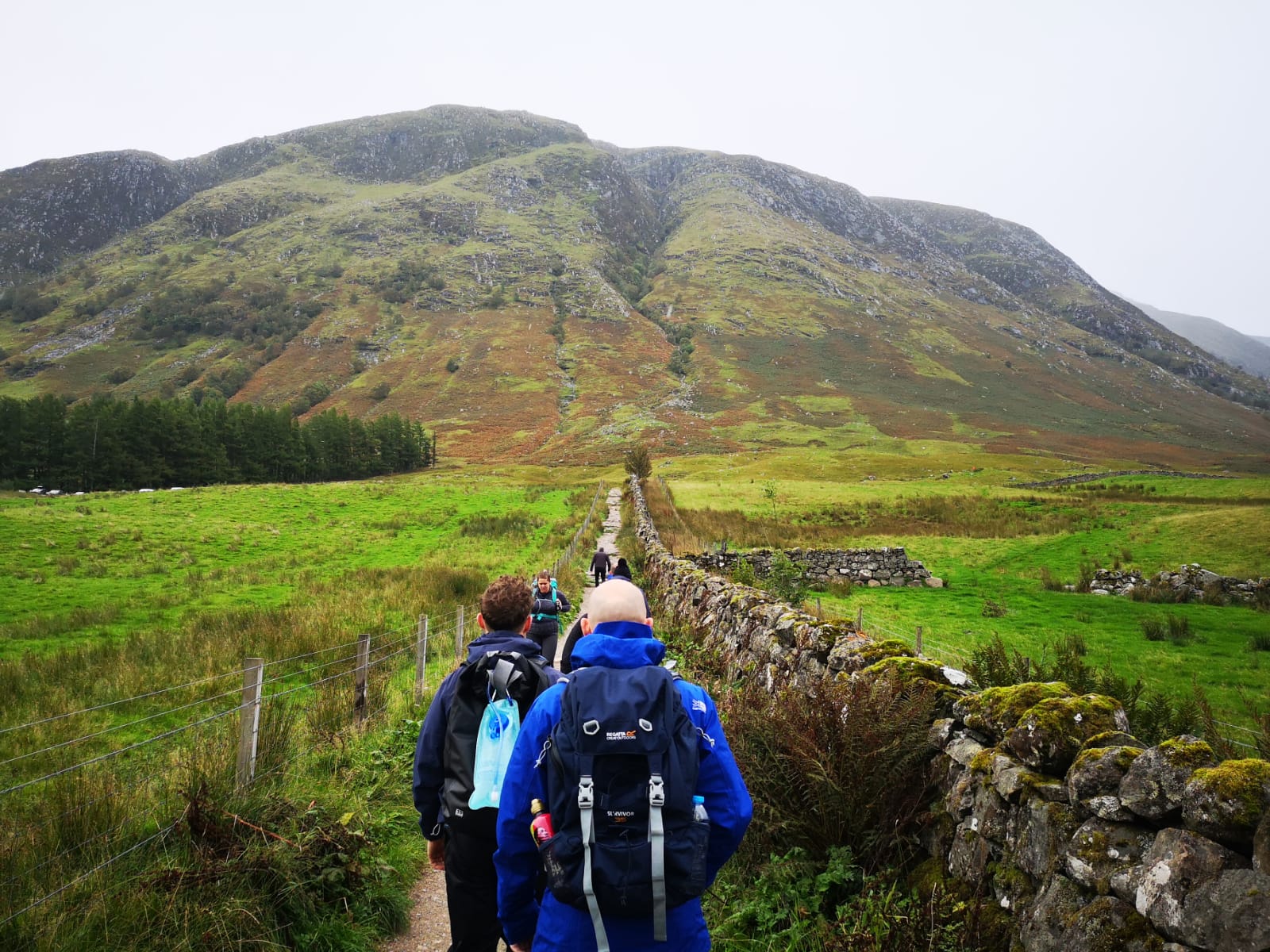

On Saturday 2nd October 2021, myself and five trusty pals (plus one legendary volunteer driver) arrived at the bottom of Ben Nevis in Scotland, all set to take on the National Three Peaks Challenge.
Notorious as one of the UK’s toughest hiking events, the challenge involves climbing the three highest mountains of Scotland, England and Wales within the space of just 24 hours. These are:
- Ben Nevis, highest peak in Scotland (1,344m)
- Scafell Pike, highest peak in England (978m)
- Snowdon, highest peak in Wales (1,085m)
Summiting each of these individual mountains is a challenge in and of itself, but after adding in the stringent time constraints, the peak-to-peak logistical difficulties and then topping it off with ever-mounting sleep deprivation – the undertaking becomes a whole new beast.
With around 30,000 hikers attempting the Three Peaks Challenge each year, only 40% actually complete it within the 24 hour limit.
I’m very chuffed to say that despite the dire weather conditions and a few hiccups along the way, we plodded on and managed to complete the challenge in a time of 23 hours 14 minutes.
Get in!
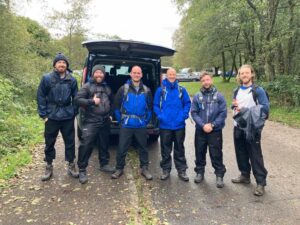
Even better, in the process we managed to raise over £2,100 for Macmillan Cancer Support.
While there are always variables and setbacks which simply can’t be planned for on this challenge, meticulous preparation was still absolutely key to our success.
With that mind, here are some top tips and lessons we learned after tackling the National Three Peaks Challenge.
Get training
Let’s get one thing out of the way – this challenge is HARD.
While you don’t have to be super fit, many still underestimate just how physically demanding the challenge will be – not realising the pace you need to keep to and how taxing the constant ascending (and descending) can become.
No matter how mentally tough you are, if your legs physically can’t keep to the required walking speed, you simply will not complete the challenge in the allocated time.
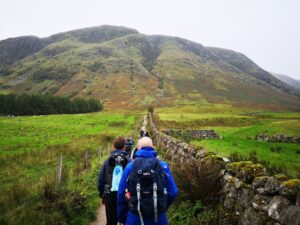
I’d class myself a pretty fit person who’s exercising most weekdays & hiking most weekends, and this challenge really pushed me.
If you’re not confident in your ability, lots of hill walking is the best way to develop the endurance required to complete the challenge.
Even better, maybe try and climb one or two of the peaks individually well before challenge day.
Running, sporting activities and generally anything that gets the lungs working will also supplement your training and help build that baseline fitness.
For more information, be sure to check out my “Training For The National Three Peaks Challenge” post.
Pack the right food
The challenge is a long and taxing 24 hours, so it’s vital that you’re sufficiently fuelling the body throughout.
What worked for me was carb-filled meals after completing each peak (pasta/sandwiches etc.) and then more sugary snacks and drinks for the actual climbing segments.
Jelly babies were an absolute life saver during the summits. If I ever felt like I was starting to lag behind, a handful of these would soon perk me up.
The occasional lucozade also helped, especially during the night climb up Scafell Pike when my body would’ve loved nothing more than some sleep in a nice warm bed!
Obviously, water is most important. We all packed more than enough to ensure everybody was sufficiently hydrated throughout.
Other notable snacks that helped me power through were: flapjacks, banana bread, fruit and nuts.
If you’re unsure just how much food and drink to bring along, just remember that it’s always better to over-pack than under-pack.
For more info, be sure to head on over to our ’10 Best Hiking Snacks To Fuel Your Next Adventure’ guide.
Set a time schedule and stick to it
Before undertaking the challenge, it’s worth allocating time slots for each segment to ensure you stay on track.
One member of our party utilised their smart watch which was able to monitor our average walking speed. Using this we could figure out just how fast we needed to be moving.
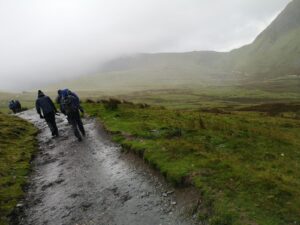
Rigidly sticking to these times kept us well on track to completing the challenge. We even tried to walk slightly faster than required when possible so that we had more leeway with the driving between each peak.
For help on timings you can check out the link here. We went with option 2 which is best for avoiding traffic.
Bring several changes of clothing
The British weather is well-known for being unpredictable, and so packing plenty of clothing is essential to staying comfortable and warm.
We had non-stop rain throughout most of our trip. The weather at the summit of the mountains also took a turn for the worse, getting caught in a nasty hailstorm at the top of Scafell and a blizzard at the top of Ben Nevis; where the temperature quickly dropped to a freezing -10 degrees.
Waterproof clothing is recommended, but this alone won’t be enough. We all wore high-quality waterproof jackets and pants, but the rain was so relentless that even they eventually lost their water-resistant capabilities.
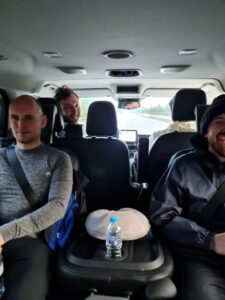
It would have been exponentially worse if we didn’t have a change of clothes and had to sit in the mini bus absolutely soaked after each of the climbs…
A top tip would be to also bring an old pair of trainers and a small towel for Scafell Pike.
Roughly a third of the way up this peak you have to traipse through a river. Because of the constant rain, the river was almost up to knee height when we came to crossing it.
To save our boots getting soaked for the rest of the trip, we opted to change into some old trainers, roll up our pants and wade through the water with our walking boots in our hands. We then quickly dried our feet and got our walking boots back on at the other side.
In addition to clothing – it goes without saying that it’s important to pack the right equipment. Check out the Three Peaks Challenge checklist here.
Have a designated driver
Trust me, with how worn out you’ll feel at the end of each climb, the last thing you’ll want to do is drive 5+ hours to the next mountain.
Originally, we were contemplating sharing the load and breaking the driving up into manageable segments between each of us. But the more we thought about it, the more we realised just how dangerous this could potentially be.
Driving along country roads in the middle of the night when you’re exhausted and sleep deprived is definitely not the smartest idea in the book…
In the end we managed to get a volunteer driver who wouldn’t partake in the actual walking. He instead got some shut eye as we walked and then had the kettle boiled for when we got back down. Legend!
Stay mentally strong
The Three Peaks is well known for being as much a mental challenge as it is a physical one.
The long drives cramped in the minibus, the sleep deprivation, the lack of a proper nutrition – it all gradually accumulates and can start to take its toll on your mind deeper into the challenge.
It’s important to stay headstrong and keep your eyes on the prize. I made sure to not engage with that inner-voice telling me to quit and instead just focused on consistently placing one foot in front of the other.
The fact we’d raised a substantial amount of money for Macmillan Cancer Support also gave me more than enough motivation to keep climbing no matter how weary I felt.
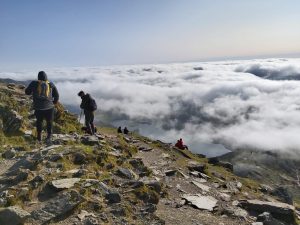
Try to enjoy it!
While the challenge is tough, it’s also great fun.
The amazing views, the excitement of getting out of your comfort zone, the comradery you develop with your team – we all had such an unforgettable time on this trip.
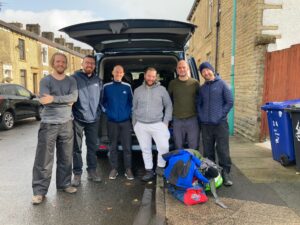
Now that my batteries are recharged a month or so removed from the venture, I’m already eager to start looking into other possible walking challenges.
On to the next one!
Strava – Recording The Three Peaks
Ben Nevis
Scafell Pike
Snowdon
More resources
For more hiking inspiration, why not check out our recent Top 10 Walking Challenges In The UK blog post?