

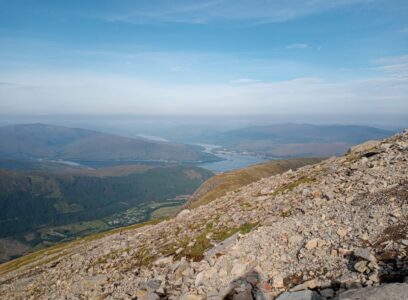
In the UK we’re certainly in no shortage of peaks to climb.
Home to an endless selection of trails big and small, Britain is often touted as a hiker’s paradise…after overlooking the unpredictable weather obviously!
For many keen walkers, conquering the three highest mountains of England, Scotland and Wales is a high priority on the bucket list. These are:
- Ben Nevis, highest peak in Scotland (1,344m)
- Scafell Pike, highest peak in England (978m)
- Snowdon, highest peak in Wales (1,085m)
The great thing about these peaks is that – while they’re certainly a challenge – they can nevertheless be climbed by pretty much anyone who’s got some hill walking experience under their belt and willing to give it a proper go.
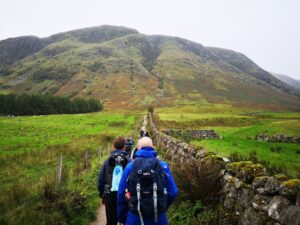
The footpaths are easy to follow for the most part – all that’s required is some basic navigational skills, the right preparation and a fiery determination to reach the summit.
In this blog post we’re going give you a complete run-down of Britain’s Three Highest Peaks.
Providing detailed info on each mountain, sprinkled in with some of our own climbing experiences, after reading this you’ll be raring to go.
The Three Peaks Challenge
Perhaps the most well-known walking challenge in the whole of the UK, the Three Peaks Challenge involves climbing the three mountains of Ben Nevis, Scafell Pike and Snowdon all in the space of just 24 hours!
While this is a great and iconic challenge, you really don’t need to do it all in one go.
Each of the peaks are enjoyable climbs in their own right, and taking away the time constraints means you can really appreciate the journey rather than simply racing from point to point.
Tips for tackling your first peak
Before attempting your first big mountain, please make sure you’re sufficiently prepared.
Mountain rescue teams have recorded their busiest periods ever since Covid, with more people travelling to these hiking destinations due to continued restrictions on international travel.
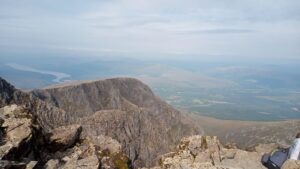
You’d be surprised how many novice climbers you see completely unequipped for the task at hand – we’ve even once spotted a lady attempting a climb in high heels!
Unfortunately, these are the kind of folk who end up getting into bother. Don’t be one of those people…
To safely walk up and down these peaks, please ensure you:
Wear the correct clothing
Walking at such high altitudes, the weather can take a turn for the worst in a heartbeat. Always pack extra layers and bring essentials such as a hat and gloves to keep your body temperature regulated. It’s also just as important to stay dry – have waterproof overtrousers and a jacket to hand in case the heavens open.
Bring the right kit
A good pair of walking boots are absolutely vital for grip and ankle stability. Other crucial equipment includes things like a map, a head torch (if you’re still walking when it gets dark), walking poles (if needed) and even crampons if there’s the possibility of snow. Click here for a full gear checklist.
*The top of Ben Nevis can see snowfall from September all the way up until May!
Pack plenty of water & snacks
It’s always better to have too much food & water rather than not enough. If you’re hiking on a particularly hot day, remember to pack even more water since you’ll be sweating a lot. In regards to snacks, high energy foods are the way to go. Jelly babies are a personal favourite of mine; the sugar really gives you that extra burst of energy!
For more information, make sure you head on over to our ’10 Best Hiking Snacks To Fuel Your Next Adventure’ blog post.
Climb with a friend
No matter how safe and precautious you are; it’s always safer hiking with a friend. Whether you take a wrong turn or take a tumble, having extra support there can help you avoid getting stuck on a mountain alone. At the very least, be sure to inform somebody you trust about your climbing plans.
Have your phone handy
Granted that signal may not always be the best, but it’s always worth having a phone to hand for communication.
Check the weather
Research what the weather conditions are looking like beforehand. It’s just not worth the risk if the weather is looking dangerous. Come again another day.
Put in the training
Start hill-walking and clocking up the miles to ensure you’re physically capable of finishing the hike come the big day. And if you do start the hike but aren’t confident in your ability to finish, don’t be afraid to turn around and try again once you’ve built your fitness.
Highest mountain in Scotland – Ben Nevis
Elevation: 1,345 metres (4,413ft)
Distance: 15.6km
Location: Western end of the Grampian Mountains
Start Point: Visitor Centre, Glen Nevis, Fort William PH33 6PF
Recommended Route: Mountain Path
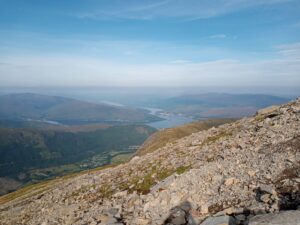
Starting with the daddy of all peaks in the UK, Ben Nevis dominates the Scottish landscape, standing at a formidable 1345 metres (4,413 feet) above sea level. Located near the small town of Fort William in the western highlands of Scotland, its estimated that over 150,000 hikers summit Ben Nevis each year.
Notorious for its unpredictable climate towards the top of the peak, Ben Nevis has arguably the most ferocious weather to be found in the whole of the UK.
Taking all of this into account, it goes without saying that it’s imperative to arrive at this mountain prepared both physically and mentally. Packing the right equipment is essential, remembering to bring extra layers to throw on as you reach the summit.

Which route to take
The most accessible route is the Mountain Path which begins at Glen Nevis visitor centre car park. Simply cross the bridge next to the visitor centre and follow the path to the top of the peak.
While this is the easiest trail to take, it’s still by no means easy! The peak is pretty much a constant steep ascent, with the winding and uneven slate footpaths towards the top of the peak seeming to go on forever.
This is where mental toughness comes into play, not being deterred and continuing to plod on, focusing on just one step at a time.
The sense of fulfillment you earn by reaching the top is undoubtedly worth it, and if you’re lucky to have visibility, the views are unrivalled.
For fit and experienced walkers, the Ben Nevis Mountain Path can be completed in around 4-5 hours. For novice hill climbers or simply those wanting to take their time, 6 hours is a more reasonable time.
It’s also recommended that novice hikers do not attempt Ben Nevis between November and May due to the extreme and unpredictable weather. The path is rocky, which becomes even more hazardous when wet, and visibility is often obscured by a mixture of rain, fog, cloud and snow.
History Of Ben Nevis
‘Ben Nevis’ is actually a translation from the Scottish Gaelic name ‘Beinn Nibheis’, which roughly translates as ‘Malicious’ or ‘Venomous Mountain’.
Other experts claim however that the name may simply mean ‘mountain with its heads in the clouds’.
For anyone who’s already conquered the Ben, I’m sure both of these names will ring somewhat true!
Evidenced by the lightly coloured granite that can be found at the top of the peak, Ben Nevis was actually an enormous ancient volcano that exploded and collapsed on itself millions of years ago.
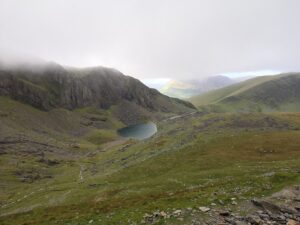
The first known man to climb Ben Nevis was James Robertson in 1771 – a Botanist from Edinburgh who came to collect botanical samples.
Interestingly, Ben Nevis wasn’t officially declared as the highest mountain in Britain and Ireland until 1847, overtaking the previous recorded highest peak, Ben Macdui, by around 100 feet.
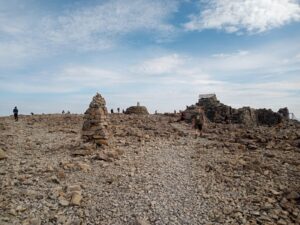
An emergency shelter is still at the top of the mountain which can be climbed inside. Funnily enough, the emergency shelter is actually higher than the trig point, making it the highest man-made structure in Britain!
What else to check out in the area
Fort William is a fantastic and pint-sized harbour town to explore – located only 2 miles from the base of Ben Nevis. There’s plenty of places to eat or drink round here, with many of the shops selling Ben Nevis themed drinks, t-shirts, books & more.
A personal favourite place of mine is the Ben Nevis distillery, which you can visit for a tour and whisky tasting session. The whisky was so good that I even had to bag myself a bottle during our last trip to the area.

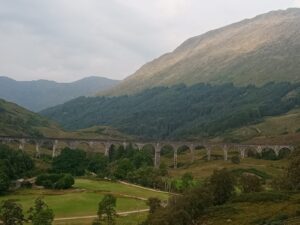
Not so far from here, you can also check out the famous viaduct used for the filming of the Harry Potter films.
Highest mountain In Wales – Snowdon
Elevation: 1,085 metres (3,560ft)
Distance: 13.96km
Location: Snowdonia National Park, Gwynedd
Start Point: Parking For Snowdon, Llanberis, Caernarfon LL55 4TU
Our Recommended Route: Llanberis Path
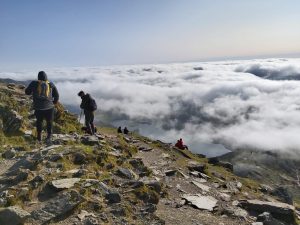
Nestled in the heart of Snowdonia National Park, Mount Snowdon looms over the stunning landscape, standing at an impressive 1,085 metres high.
Offering the most variety of routes to take out of the three peaks, Snowdon has a total of six distinct paths to reach the summit. Plus, if you don’t fancy the hike, you can always simply just jump on the mountain railway to the summit instead!
It’s perhaps not surprising that Snowdon has recently been dubbed the ‘busiest mountain in Britain’.
Becoming even more popular since Covid lockdown restrictions, its estimated that Snowdon now attracts roughly 700,000 visitors per year.
Which route to take
While my personal favourite trail to take is the Watkin Path (one for a future blog post), for beginner hikers I would say the Llanberis Path is the best option by far.

The Llanberis Path offers stunning views and a challenging climb, yet avoids any of the steep scramble segments present on routes such as Watkins Path or Crib Goch which may intimidate less experienced hikers.
However, being the most accessible route means that Llanberis Path is also the busiest. To avoid the crowds we’d recommend getting up and down early in the morning before the droves of people arrive.
As with any peak, there are dangers to avoid. While in summer this route is relatively straightforward, winter can make it a particularly more hazardous climb.
The notoriously dangerous winter segment on Snowdon is aptly named the Killer Convex. In heavy snow, the path vanishes and you’ll have to navigate your own way up (and back down) the very steep slope.
Even if fully equipped with all the correct gear, this is definitely not a mountain for beginners to summit during the winter months.
To fully appreciate the stunning views from above it’s best to ascend Snowdon on a clear day anyways.
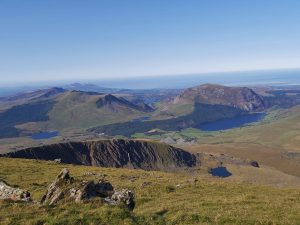
You’ll enjoy breath-taking views of the surrounding countryside, including Cwm Brwynog, Llanberis and even all the way out towards the isle of Anglesey!
History Of Snowdon
Dating back to over 400 million years ago, ancient volcanoes were responsible for creating Snowdon’s uniquely spectacular rock formations. Much later (only around 18,000 years ago), glacial activity then helped shape the characteristic U-shaped valleys which are present throughout Snowdonia National Park today.
In Welsh, Snowdon is called ‘Yr Wyddfa’, which roughly translates to ‘The Great Tomb’.
Legend has it that Mount Snowdon is actually the tomb of a giant named ‘Rhita Gawr’, a fearsome creature who’d kill men and fashion cloaks with their beards.
The giant was slain in an epic battle against King Arthur. Arthur and his men then piled rocks on the giant corpse before returning home – creating the boulders at the peak of Snowdon.
Nobody is certain who was the first to reach the summit, but ventures to Snowdon quickly grew in frequency after Thomas Pennant published his book ‘Tours’ in 1871, which journalled his trip up the mountain.
While nowadays the mountain railway is a popular and convenient way of reaching the top of Snowdon, before it was built people would instead ride ponies up the steep paths.
Sir Richard Moon and George Asheeton Smith came up with the idea of the railway, and despite an accident on the first day of opening in 1896, there hasn’t been a single accident since!
What else to check out in the area
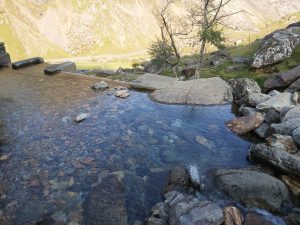
One of our personal favourite spots in Snowdonia National Park is the Secret Inifinty Pool. Check out the link if you want help discovering the location. It’s very close to the Llanberis Path so it’s not far from the peak at all…
The town of Llanberis is also worth checking out. A quaint village with a stunning lake and lots to explore, you can read up on our camping trip here last year if you fancy learning more.
Highest mountain in England – Scafell Pike
Elevation: 978 metres (3,209ft)
Distance: 8.8km
Location: Lake District National Park, Cumbria
Start Point: Wasdale Head Car Park for Scafell Pike, Wasdale Head, Seascale CA20 1EX
Recommended Route: Route from Wasdale Head
Despite not being quite as high as Ben Nevis or Snowdon, Scafell Pike is still the largest mountain in England, standing at a very impressive 3,209 feet.
While being the smallest of the three peaks, Scafell Pike is certainly the most difficult to navigate. The last time I actually attempted this peak was in the dead of the night during our Three Peaks 24 Hour Challenge. The hailstorm on the way back down made it even more precarious.

This is where navigational skills are essential. Despite not being able to clearly see the path with our eyes, we could use maps on our phone to stick closely to the designated route and not wander off the beaten track.
If possible, its best to follow the advice of Alfred Wainright, who instructs that to get the most out of this peak, it’s best to start early and wait for good weather!
Situated in the heart of the Lake District, it’s not surprising to note that the views from the summit are absolutely gorgeous.
Which route to take
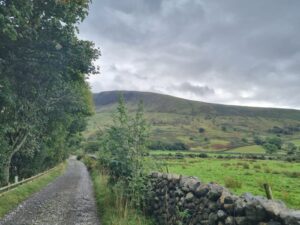
Parking at Wasdale Head Car park, the route begins relatively straight forward. Follow the footpath beside the river until you get up to the river crossing.
This is where you’re going to get wet. Depending on the weather, the depth of the river can range from relatively shallow to as deep as knee-height!
Anticipating a deep river crossing due to heavy rain on our last visit to Scafell, we all each packed a pair of old shoes and a small towel. Crossing the waters in our old trainers, we quickly dried our feet at the other side and strapped our walking boots back on to continue the trek.
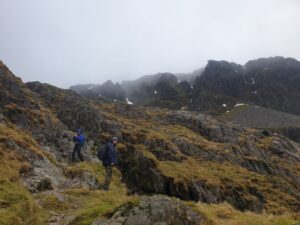
The path remains relatively easy to follow after the river crossing, becoming trickier to navigate towards the last third of the climb. This is where having a compass, map or a navigational app on your phone is essential.
Once you reach the trig point it’s the same way back down, paying close attention to ensure you stay on route. The peak is characterised by ruggedness and crags however, so be sure to watch your footing.
History Of Scafell Pike
One of England’s most iconic peaks, the summit of Scafell Pike was actually handed over to the National Trust by Rt. Hon. Lord Leconfield as a war memorial in 1919.
A commemorative plaque on the mountaintop reads:
“In perpetual memory of the men
of the Lake District who fell
for God and King, for freedom
peace and right in the Great War
1914–1918.
This summit of Scafell
was given to the nation subject
to any commoners rights & placed
in the custody of the National Trust
by
Charles Henry, Baron Leconfield,
1919”
Having now enjoyed public ownership for over 100 years, Scafell Pike attracts over 250,000 tourists each and every year.
The distinctive landscape of the Lake District is the result of ancient volcanic activity and glacial movements, creating a whole array of iconic walks and peaks for us to enjoy in the National Park today.
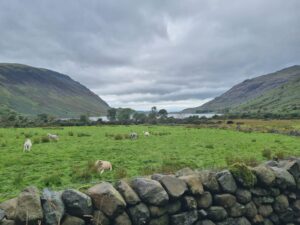
It’s speculated that Scafell Pike derives its name from Old Norse, the language of the medieval Vikings who invaded and settled in the area from around the 9th Century.
Interestingly, evidence of both Viking and Roman settlements can be found throughout the borough of Copeland where Scafell Pike is situated.
Originally named skalli fjall – translating to ‘fell with the bald summit’ – written recordings and pronunciation of the peak gradually changed through the years, leading to the modern name ‘Scafell Pike’ that we all commonly use today.
What else to check out in the area
Now the Lake District is one of my favourite places, so I could waffle on forever about what to see and do here.
Only a 30-minute drive from Scafell Pike you can visit the charming village of Grasmere; a village that famous poets William and Dorothy Wordsworth called “the loveliest spot that man hath ever found.”
William and his wife have a tombstone in the St Oswald’s Church graveyard in the heart of the village; one of the most visited literary graves in the world.

With plenty of gift shops to explore and eateries to try, my personal favourite spot in the village is the Grasmere Gingerbread shop. A secret recipe dating all the way back to 1854, you’ll struggle to find better gingerbread than this.
Buttermere is another gorgeous area to explore, only 6 miles from Scafell Pike. Check out our blog post and see what we got up to on our last camping trip here.
Conclusion
Hopefully after reading this blog post you’re now feeling more equipped to head out and conquer the highest peaks in Britain.
Ben Nevis, Snowdon and Scafell Pike are all such great climbs – challenging, stunning and extremely rewarding.
Just prepare accordingly and don’t be afraid to call it a day if you don’t feel that you can make it to the top safely.
Good luck, have fun and be safe.
More resources
For more hiking inspiration, why not check out our recent post listing ’10 Of The Best Mountains To Climb In The UK’?
Happy walking 🚶🚶